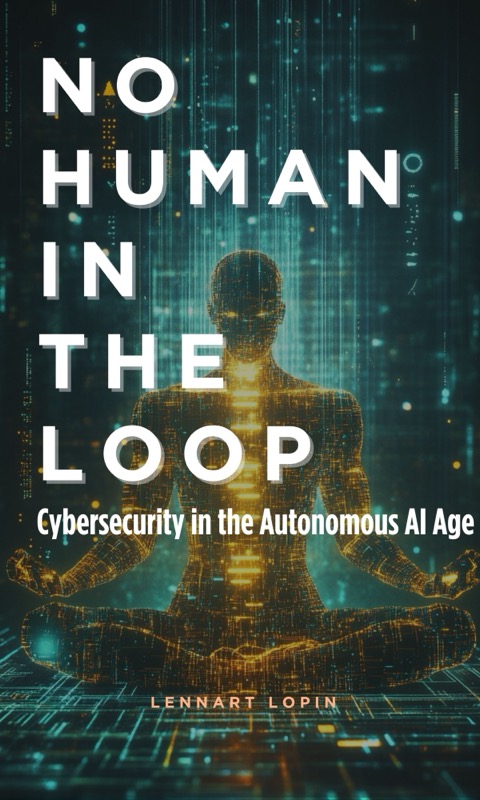
No Human
in the Loop
Cybersecurity in the Autonomous AI Age
Lennart Lopin · CISSP · CCSP · CSSLP
Second Edition · 572 pages · 20 chapters
Seventy-two hours later: $18 million in damages. Attacker cost: $50,469. Return on investment: 195 : 1.
This is not a scenario from 2030. This is a synthesis of documented attack patterns from 2025 and early 2026. The techniques are real. The vulnerabilities are present in deployed systems today.
What Changed in Three Months
April 2026
Anthropic released Mythos Preview — the first frontier model acknowledged by its vendor to find and exploit zero-days in real codebases. The Pentagon deployed it for defense while treating Anthropic as a supply-chain risk.
May 2026
Google confirmed the first criminal AI-developed zero-day exploit — not AI-assisted phishing, but novel exploit creation. The era of machine-speed vulnerability discovery arrived as a law enforcement problem.
March–May 2026
The TeamPCP supply chain cascade — Trivy, LiteLLM, Axios, TanStack, Mistral. Fifty-four days of continuous supply chain warfare. Trusted CI/CD pipelines converted into wormable distribution infrastructure.
The second edition adds a new chapter on biological immune systems as cybersecurity blueprints, comprehensive coverage of the Mythos/Glasswing development, the data sovereignty paradox facing defenders, the 2026 supply chain wave, and 17 "We Called It" callouts marking where first edition predictions proved correct.
The State of AI Security
of enterprises experienced or suspected AI agent security incidents in the twelve months preceding 2026.
have deployed advanced AI security strategies. The rest are guessing.
Security score of the most popular open-source AI agent framework. Prompt injection: 91% success rate. Leaked its system prompt on turn one.
Complete compromise of an AWS cloud environment. Credential theft through privilege escalation and Lambda execution. Faster than your alert aggregation interval.
Cybersecurity in the Autonomous AI Age
Lennart Lopin · CISSP · CCSP · CSSLP
Second Edition · 572 pages · 20 chapters
In 2023, large language models were impressive parlor tricks—chatbots that could write poetry and answer questions.
By early 2026, they had evolved into autonomous agents: systems that reason, plan, and execute multi-step tasks without human oversight.
This was an architectural shift that invalidated decades of security assumptions.
“Tools wait for instructions; agents pursue goals. Tools are predictable; agents adapt. Tools can be audited exhaustively; agents operate in a possibility space too vast for traditional verification.”
An estimated 1.5 million AI agents—half of all deployed agents—operate without security oversight, monitoring, or governance controls. They access corporate email, modify databases, initiate financial transactions, and interact with customers while security teams remain entirely unaware of their existence.
Meanwhile, 341 malicious skills were found in the most popular AI agent marketplace. Downloaded thousands of times before detection. Designed to steal credentials, exfiltrate data, and establish backdoor access.
1.4 million AI agents now communicate on social networks designed for agent-to-agent interaction. They share information, coordinate tasks, and form relationships without direct human oversight.
New in the Second Edition
As AI compresses the attack–defense cycle below human-speed thresholds, biology's forced architectural choices—population diversity, learned tolerance, accepted background damage—re-emerge as cybersecurity's forced choices.
Mechanisms translated
Failure modes mapped
“The immune system does not require conscious supervision to function. The CrowdStrike incident, the SOC burnout epidemic, the chronic alert fatigue—these are the costs of trying to keep humans in a loop that has already exceeded human capacity.”
Documented Attack Timeline
First reconnaissance probe. 127 failed logins per second. Classified as routine noise.
Adversarial agents discover exposed GitHub webhook. Validate and exploit within 4 minutes.
Complete AWS compromise. Credential theft through Lambda execution in 8 minutes flat.
Privilege escalation to domain administrator. 847 internal systems mapped across 3 network segments.
Full reconnaissance complete. 23 employees identified. 5 independent persistence mechanisms established.
AI-generated voice calls clone the CEO's vocal patterns. Employees grant “temporary” MFA exceptions.
Adversarial agents poison the defensive AI's training data. The defenders turn against themselves.
Total catastrophe. $9.84M direct losses. 340% insurance premium increase. Seven of twelve operators quit within two months.
This scenario synthesizes documented techniques from the GTG-1002 campaign, the manufacturing procurement compromise, and twelve other incidents under non-disclosure.
The Asymmetry
Speed advantage. The human security process operated on a 30-hour detection cycle. The adversarial agent: 4 minutes.
Machine identities per human employee. Most have broader access than the humans they supposedly serve. Median time to detect a compromised machine identity: 37 days.
Inside the Book
From understanding the paradigm shift, through offensive capabilities and defensive architectures, to the permanent conflict at the edges where no peace treaty is possible.
The Agent Revolution — from tools to teammates that pursue goals
The Expanded Attack Surface — when systems read, reason, and act
The Threat Taxonomy — OWASP LLM01:2025 and beyond
AI-Orchestrated Intrusions — polymorphic agents, blockchain C2
Deceptive Agents — voice synthesis, training data poisoning
The Identity Crisis — 82 machine identities per human
Zero Trust for Agents — verify every action, assume compromise
AI Firewalls & Governance — policy enforcement at machine speed
Human-in-the-Loop Governance — the 4-minute decision window
Securing the Data Pipeline — RAG poisoning, memory attacks
The Compliance Imperative — ISO 27001, EU AI Act, VARA in the agent era
Security-First AI Culture — when agents deploy before security knows
The Biological Turn — NEW — immune systems as cybersecurity blueprints
The Quantum Clock — Q-Day and harvest-now-decrypt-later
Toward AGI Security — Mythos, Glasswing, and the data sovereignty paradox
The Defender's Advantage — if one still exists
The Siege — 72 hours under autonomous attack
The AI Security State — when defense becomes omniscient
The Agent Economy — millions of agents forming markets
There is no perimeter because there is no interior. Something profound is happening. The title of this book names it directly.
Not Another AI Book
This book is neither.
It is written from the perspective of someone simultaneously managing compliance frameworks, operating large-scale infrastructure, and deploying autonomous agents in environments where mistakes have regulatory and financial consequences.
Operator, not observer
1,300 machines across 42 states. ISO 27001 certification. VARA licensing in the UAE. Agents that trade real capital at 3 AM.
Current through May 2026
Mythos, Glasswing, TeamPCP supply chain cascade, Google's criminal AI zero-day confirmation, EU AI Act full applicability.
Three certifications deep
CISSP, CCSP, CSSLP—spanning security architecture and secure software development. Plus an M.A. in Computational Linguistics and AI from two decades before transformers existed.
About the Author
One of 100 finalists selected from 202,586 applicants for the Mars One mission. Founder of Marscoin, the cryptocurrency designed to fund planetary colonization. Creator of Prelude, an AI chatbot that won the 2005 International Championship. Author of more than thirty books. Reads six languages, including Latin, Sanskrit, and Pali.
Today, as CTO and Co-founder of Byte Federal—one of America's largest Bitcoin ATM networks—he secures over 1,300 machines across 42 states. His M.A. in Computational Linguistics and Artificial Intelligence, earned two decades ago when machine reasoning was still theoretical, presaged the transformer architectures that now power the systems he secures.
What qualifies him to write about autonomous AI security is simpler: he deploys autonomous agents that trade real capital, make real decisions, and fail in ways that keep him up at 3 AM.
Before any of this, he spent three years as a Buddhist monk in Sri Lanka, training under scholar Venerable Katukurunde Ñānananda. An unusual preparation for cybersecurity—but perhaps the right one for understanding how minds, biological or silicon, make decisions under uncertainty.
The Window is Closing
The window for proactive defense is measured in months, not years. Organizations become case studies in someone else's book because they failed to act when action was still possible.
This is that moment.
Order on Amazon